· Maya Sinclair
How to Play a Crystal Singing Bowl
After testing over 200 bowls, the single biggest gap we see between a beginner's first try and a confident player isn't the bowl, it's technique. This guide covers the two core playing methods, correct grip, and the specific mistakes that keep a tone from sustaining.
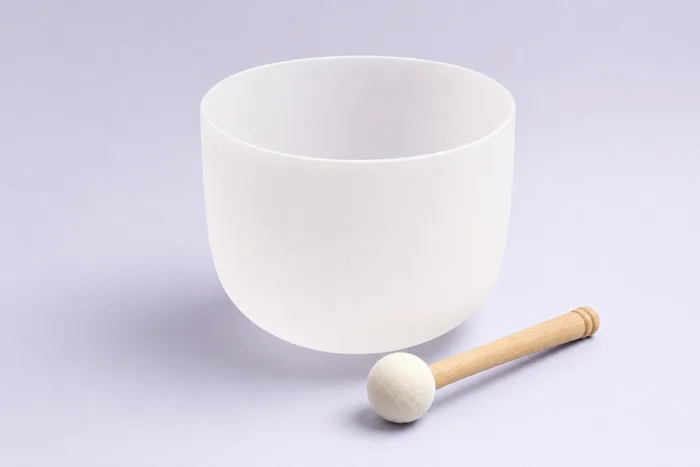
Striking vs rimming: the two core techniques
| Technique | How it works | Best for |
|---|---|---|
| Striking | Tap the outer wall once with the padded end of the mallet, then let it ring out fully | Beginners, starting a session, marking a phase change |
| Rimming | Press the mallet against the outer rim at a slight angle and circle it steadily around the edge | A sustained, continuous tone during meditation or a sound bath |
Most people start with striking because it's forgiving. Rimming produces the long, "singing" tone the instrument is named for, but it takes a few sessions to get consistent.
Correct mallet grip
Hold the mallet the way you'd hold a pen, not a drumstick. Your grip should be relaxed, with the mallet resting in the web of your hand between thumb and index finger. A death grip is the single most common reason a rimmed tone won't sustain: tension in your hand transfers directly into uneven pressure on the bowl.
For striking
Hold the mallet loosely near the end of the handle and let the padded head do the work. A light, controlled tap produces a fuller tone than a hard hit, which tends to produce a short, harsh sound instead of a clean bell tone.
For rimming
Angle the mallet slightly toward the bowl (roughly 10-20 degrees from vertical) and press it against the outer rim with steady, even pressure, moving in a consistent circular path. Speed matters less than consistency: a slow, steady circle beats a fast, uneven one every time.
Common beginner mistakes
- Pressing too hard while rimming. This causes the mallet to "catch" and skip instead of gliding, which breaks the tone.
- Moving the mallet too fast around the rim. A rushed circle produces a thin, inconsistent tone. Slow down until the tone locks in, then maintain that pace.
- Changing angle mid-circle. Keep the mallet angle constant. A shifting angle is the most common reason a tone that started clean suddenly wobbles or cuts out.
- Playing on an unstable or soft surface. Set the bowl on a firm, stable base (a proper stand, or a hard non-slip surface) rather than a lap or cushion, which absorbs resonance.
- Gripping the mallet too tightly. Tension travels straight into the bowl. Relax your hand and let the mallet's own weight do more of the work.
Getting a clean, sustained tone
A clean sustained tone comes down to three things staying constant at once: pressure, angle, and speed. Practice each in isolation before combining them. Rest the bowl on a firm surface, find a light, even pressure, and circle slowly at a fixed angle for at least ten full rotations before judging whether the tone is "working." Most beginners give up two or three rotations too early.
A quick note on tuning: 432 Hz vs 440 Hz
Our bowls are available tuned to either 432 Hz or 440 Hz depending on the note and combination you choose. It's worth understanding where these numbers come from before you decide which matters to you.
Year the International Organization for Standardization formally adopted A = 440 Hz as the standard reference pitch (ISO 16)
— International Organization for Standardization, 1955
440 Hz is the internationally standardized concert pitch used across most modern instruments. 432 Hz is an alternative tuning favored in wellness and sound-healing communities for a perceived warmer tone, but it is not an officially standardized frequency and there's no established scientific evidence that it has a distinct physiological effect over 440 Hz. We sell both because different players have a genuine ear preference, not because one is scientifically proven "better." For more on how frequency choice affects your session, see our frequency guide.
Why crystal bowls play differently than metal bowls
Crystal singing bowls are cast from crushed quartz sand melted at extreme heat, rather than hammered like a traditional Tibetan bowl. That manufacturing method is part of why the tone behaves the way it does under a mallet.
Approximate melting point of silica (quartz sand), the raw material crystal bowls are cast from
— CRC Handbook of Chemistry and Physics, 2023
Hardness of quartz on the Mohs mineral hardness scale, which is why the bowl wall resists everyday scuffing from a padded mallet
— Mohs hardness scale, Friedrich Mohs, 1812
Because crystal bowls are cast as a single, precisely shaped piece, their tone is more uniform and predictable across the rim than a hand-hammered metal bowl, which is one reason beginners often find crystal bowls slightly easier to learn rimming on. If you're comparing the two styles, our crystal vs Tibetan comparison covers this in more depth.
Troubleshooting a tone that won't start
If rimming produces nothing but a scraping or clicking sound instead of a tone, work through these in order before assuming the bowl is the problem.
Check the surface first
Set the bowl on a firm, stable base rather than your palm or a lap cushion. A bowl held in an unstable hand dampens vibration before it can build into a sustained tone, which is the single most common reason a first attempt goes silent.
Check your pressure, not your speed
Beginners almost always try to fix a weak tone by moving faster. Slow down instead and lighten your pressure by roughly half. A tone builds gradually as friction between mallet and rim finds a consistent rhythm; speeding up before that rhythm locks in just resets the process.
Check the mallet contact point
Keep the mallet against the outer rim, not tipped inward toward the bowl's interior wall or outward off the edge entirely. A few millimeters of contact-point drift is enough to kill a tone that was building.
Give it more rotations than feels natural
A tone that starts thin and inconsistent for the first five or six rotations often locks into a clean, full tone by rotation ten or twelve. Most beginners stop right before that point and conclude the technique isn't working.
How bowl size affects technique
Larger bowls (10-12 inches, found in our 3-bowl set and the 7-bowl practitioner set) generally need slightly more mallet pressure and a wider circling radius to sustain a tone, since there's more mass to set vibrating. Smaller bowls (6-8 inches) respond to lighter pressure and a tighter circle, and tend to be more forgiving for a first-time player learning grip and pressure control from scratch.
Practicing technique inside a real session
Technique matters most in the "Sound" phase of a meditation session. If you haven't settled on a session structure yet, our meditation practice guide lays out a simple 4-part template you can drop this technique straight into. And once you're comfortable playing, proper cleaning and care keeps the bowl's tone consistent for years.
When to move up in bowl count
A single 8-inch bowl is plenty while you're learning grip and pressure control. Once striking and rimming both feel natural, the 3-bowl set adds tonal range for longer sessions, and our full sound healing guide covers how practitioners sequence multiple bowls together. If you'd like a second opinion on which setup fits your skill level, our team is happy to help, and our testing methodology explains exactly how we evaluate tone quality across bowl sizes. Real buyer feedback on tone and build quality is posted honestly on our reviews page.