· Maya Sinclair
How to Clean and Care for a Crystal Singing Bowl
A crystal singing bowl is durable, but the frosted finish that gives it that soft, matte look is more delicate than the crystal underneath. Most of the damage we see reported isn't cracking, it's dulling or fine scratching from the wrong cleaning routine. Here's what actually protects a bowl long term.
What to use
- A soft, dry microfiber cloth for routine dusting
- A microfiber cloth lightly dampened with plain water for fingerprints or light residue
- A soft dry brush or compressed air for dust in the base ring detail
What NOT to use
| Product | Why to avoid it |
|---|---|
| Glass or window cleaner | Contains ammonia and solvents that can leave streaks or a filmy residue on the frosted finish |
| Vinegar or acidic cleaners | Not needed on quartz and can interact with any surface coating or residue on the finish over repeated use |
| Alcohol-based wipes | Can dry out and dull the matte frosted texture with repeated use |
| Abrasive sponges or paper towels | Fine abrasion builds up over months of use and leaves micro-scratches visible under bright light |
| Dishwasher or submerging in water | Unnecessary risk to the base ring detail and the o-ring seat; hand-clean only |
Why the frosted finish needs gentler care than raw quartz
Quartz itself is a genuinely hard mineral, which is part of why these bowls hold up so well to years of mallet contact.
Hardness of quartz on the Mohs mineral hardness scale, harder than a steel knife blade (5.5)
— Mohs hardness scale, Friedrich Mohs, 1812
That hardness protects the bowl from dents and everyday mallet contact. What it doesn't protect is the frosted (matte) surface texture, which is a fine physical texture on top of the crystal, not a coating. Harsh chemical cleaners and abrasive cloths won't crack the bowl, but they can gradually smooth or discolor that texture, which is why we recommend the gentlest option that actually works: a dry or barely damp microfiber cloth.
Quartz resists nearly all household solvents and acids except hydrofluoric acid, but its frosted surface texture is still vulnerable to abrasive wear
— U.S. Geological Survey, Mineral Commodity Summaries, 2024
In practice, that means the crystal itself is nearly impossible to damage chemically at home, but the finish's texture is a physical, not chemical, concern, so a soft cloth beats any cleaning product every time.
How to store your bowl between uses
- Keep the bowl upright rather than resting on its rim, which is the most load-bearing edge.
- Store it in its case (single bowl and 3-bowl set) or padded carrying case (7-bowl set) when not in daily use, especially if you have pets or young children nearby.
- Keep the mallet and rubber o-ring in the same spot as the bowl. The o-ring prevents direct contact with hard surfaces and is easy to misplace once separated from the case.
- Avoid stacking anything on top of the bowl, even lightly, since sustained pressure on the rim over time can affect tone.
A note on the carrying case
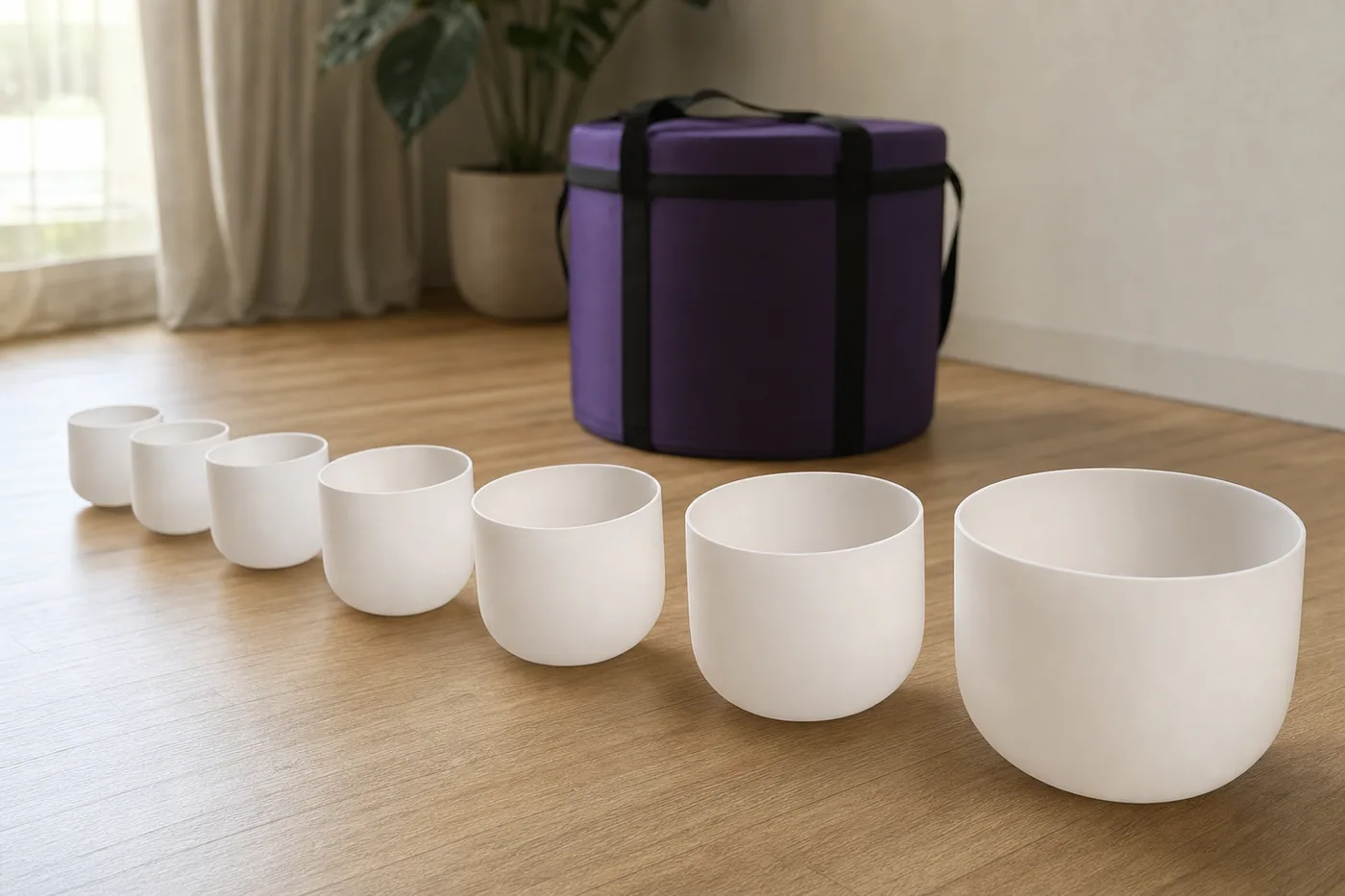
Our 7-bowl practitioner set ships with a padded, zippered carrying case with a shoulder strap. Because these are sourced across production batches, case color varies (we've seen both violet and olive/khaki in recent shipments), and we'd rather tell you that upfront than promise a specific color we can't guarantee. Either way, the case itself is built the same: padded interior, zip closure, and a strap for transport, which is what actually protects the bowls in transit.
Traveling or shipping your bowl
If you're a practitioner moving bowls between sessions, keep them in their padded case with the mallets tucked into their dedicated slot rather than loose, since loose mallets are the most common cause of in-transit scuffs on the rim. For solo practice at home, the case doubles as safe storage even if you never leave the house with it.
Cleaning the mallet and o-ring
The padded mallet head and rubber o-ring get more direct hand contact than the bowl itself, and they're often forgotten in a cleaning routine. Wipe the mallet handle with a dry cloth after use, and check the padded head periodically for wear, since a worn or compressed pad changes how a strike sounds. The o-ring rarely needs anything beyond an occasional wipe, but replace it if it becomes cracked or loses its shape, since a worn o-ring lets the bowl sit unevenly and can affect tone.
A simple seasonal deep-clean checklist
- Wipe the entire bowl, inside and out, with a barely damp microfiber cloth.
- Dry immediately with a second, dry microfiber cloth, don't let it air-dry with moisture sitting on the surface.
- Inspect the base ring detail for dust buildup and clear it gently with a dry brush.
- Check the mallet pad and o-ring for wear and replace either if needed.
- Return everything to its case in the same arrangement so nothing gets misplaced before the next session.
When cleaning issues might mean something else
If you notice a persistent dull spot after gentle cleaning, or the tone has changed noticeably since purchase, that's usually not a cleaning problem, it's worth checking your playing technique first. Uneven mallet pressure over time can affect the surface locally. Our how to play a crystal singing bowl guide covers correct grip and pressure, which prevents most of this before it starts.
Putting it into a routine
Wipe the bowl down with a dry microfiber cloth after each session, do a light damp-cloth pass weekly if you play daily, and store it properly between uses. That's genuinely the whole routine, there's no special polish or treatment needed. If you're building a regular meditation practice around your bowl, this care routine takes under a minute and fits naturally into the "Close" phase of a session.
Choosing the right bowl in the first place
Proper care matters more the more you use a bowl, and usage has been climbing as more people adopt short daily relaxation practices generally.
Growth in the share of US adults reporting a regular meditation practice over one decade
— National Center for Complementary and Integrative Health / CDC National Health Interview Survey, 2022
If you haven't chosen a bowl yet, our single 8-inch bowl is the easiest to care for day to day, while the 3-bowl set and 7-bowl practitioner set need slightly more storage planning given the extra pieces. Our how we test page explains how we evaluate durability and finish quality before recommending any bowl, and honest, unedited feedback from real buyers is on our reviews page. Questions about a specific bowl or case? Reach us through contact, or read more about our approach on about. For background on how crystal bowls differ structurally from traditional metal ones, our crystal vs Tibetan comparison covers the manufacturing differences that drive some of this care advice.