· Maya Sinclair
Crystal vs Tibetan Singing Bowls: Key Differences
We sell crystal bowls, so it would be easy to quietly talk down the Tibetan tradition. We're not going to. Both instruments have real strengths, and the right choice depends on what kind of tone and practice you're after, not which one is "more authentic."
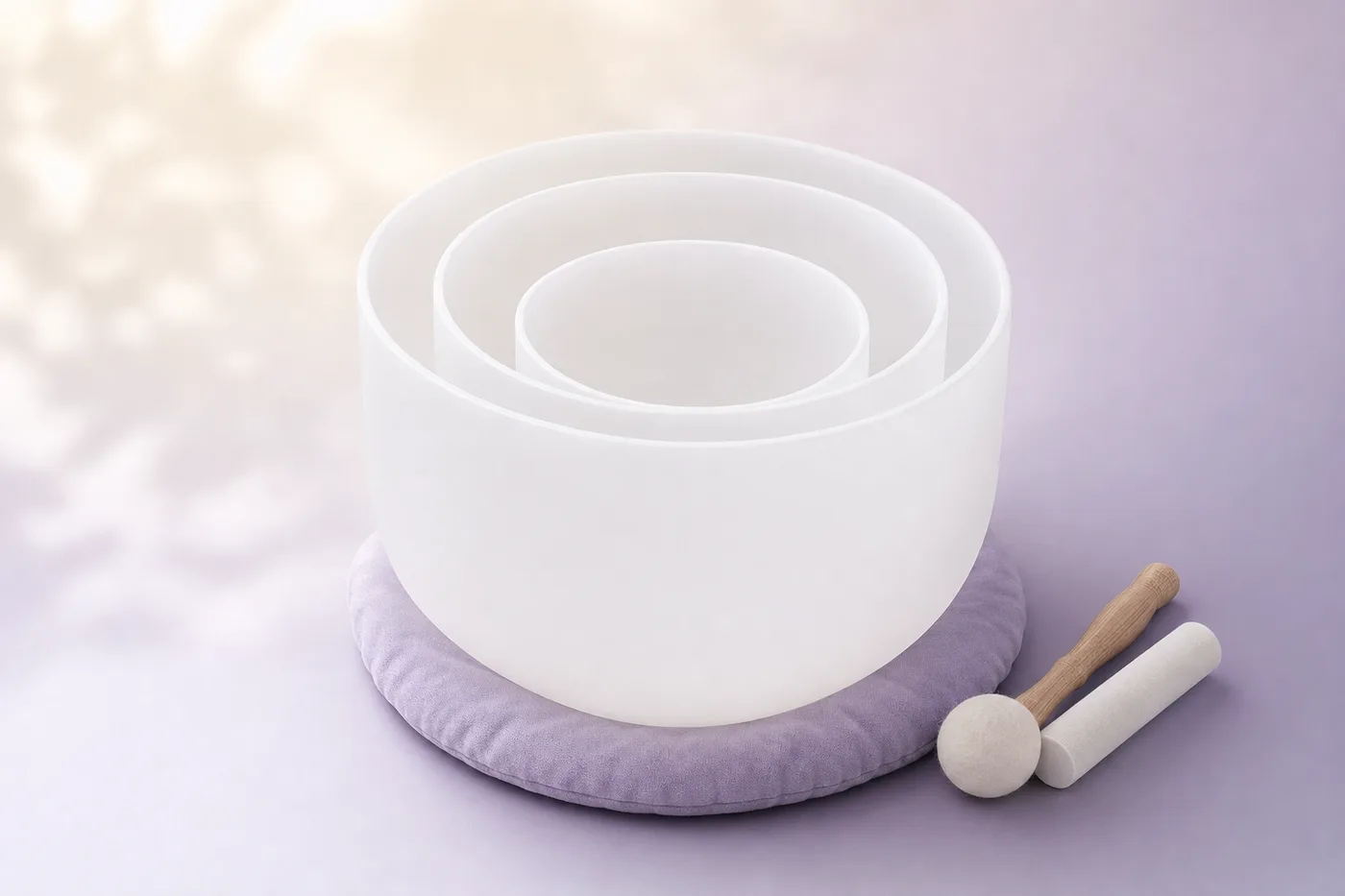
How each bowl is made
The manufacturing process is the biggest structural difference between the two, and it explains almost every other difference in tone and consistency.
Crystal singing bowls
Crystal bowls are cast from crushed quartz sand, melted at extremely high heat and spun in a mold to form the bowl's shape before cooling.
Approximate melting point of silica (quartz sand), the raw material crystal bowls are cast from
— CRC Handbook of Chemistry and Physics, 2023
Because each bowl is cast in a mold to a specific size, manufacturers can precision-tune it to a target note and frequency (432 Hz or 440 Hz) with high consistency between bowls of the same size.
Tibetan singing bowls
Traditional Tibetan bowls are hand-hammered from a metal alloy, historically described in early Western reference literature as a blend of several metals.
Traditional alloy composition described for historic Tibetan singing bowls in early Western reference literature (a traditional description, not an independently verified metallurgical standard)
— Eva Rudy Jansen, Singing Bowls: A Practical Handbook of Instruction and Use, 1990
Because each bowl is shaped by hand, no two are perfectly identical, even within the same batch. That's not a flaw, it's the source of the rich, layered overtones collectors specifically seek out in hand-hammered bowls.
Side-by-side comparison
| Crystal singing bowl | Tibetan singing bowl | |
|---|---|---|
| Material | Cast pure quartz (frosted/matte finish) | Hand-hammered metal alloy |
| Tone character | Higher, purer, single dominant tone | Warmer, layered with rich overtones |
| Tuning precision | Precision-tuned to a specific note/Hz | Naturally variable, bowl to bowl |
| Sustain | Long, clean sustain when rimmed | Shorter sustain, complex decay |
| Consistency | High, same size/note plays predictably | Lower, each bowl has its own character |
| Tradition | Modern (developed for sound therapy/music use) | Centuries-old Himalayan craft tradition |
| Typical use | Meditation, sound baths, chakra-note work | Meditation, ritual, collector/heirloom pieces |
Tuning: precision vs natural variation
Because crystal bowls are cast to spec, each one can be tuned to a specific note tied to a chakra association, which is part of why our single bowl ships with a 7-note dropdown and our 3-bowl set offers 15 real note-and-frequency combinations. Tibetan bowls, by contrast, are typically sold by their natural resulting tone rather than an exact target note, since hand-hammering doesn't produce the same precision.
Year the International Organization for Standardization formally adopted A = 440 Hz as the standard reference pitch (ISO 16)
— International Organization for Standardization, 1955
440 Hz is the internationally standardized pitch reference; 432 Hz is a popular alternative tuning in wellness circles without formal standardization or established scientific evidence of a distinct physiological effect. Our frequencies guide covers this distinction in more depth if you're deciding between the two tunings.
Tone: purity vs complexity
A crystal bowl produces something close to a single, clear, sustained pitch, which is why they're popular for chakra-note meditation where a specific frequency matters. A Tibetan bowl produces a denser blend of overtones, which some practitioners find more textured and meditative, and others find harder to focus a single note around. Neither is more "correct." A sound bath using several crystal bowls in sequence and one using several Tibetan bowls will feel genuinely different, and many practitioners eventually use both for different parts of a session.
Durability and everyday care
Quartz is a genuinely hard material day to day.
Hardness of quartz on the Mohs mineral hardness scale, meaning the crystal itself resists everyday dents and scuffs well
— Mohs hardness scale, Friedrich Mohs, 1812
Metal alloy bowls are also durable but age differently, developing a patina over years of handling, which many owners consider part of the bowl's character rather than a flaw. Crystal bowls, by contrast, keep a consistent frosted appearance but need the gentler cleaning approach we cover in how to clean a crystal singing bowl, since the matte finish is more delicate than the crystal underneath.
Price and accessibility
Crystal bowls and quality hand-hammered Tibetan bowls occupy a similar price range once you account for size and craftsmanship, though pricing on the Tibetan side varies more widely, since hand-forged pieces from a known maker command a premium that mass-produced tourist-market bowls don't. Crystal bowls, being cast to a consistent spec, tend to have more predictable pricing across a given size and tuning. Neither instrument requires expert-level spending to get a genuinely good beginner bowl; the difference shows up more in tone character than in entry cost.
A practitioner's perspective
Practitioners who run group sound baths often end up choosing based on the room, not just personal preference. Crystal bowls' longer, purer sustain tends to fill a large room evenly, which is part of why our 7-bowl practitioner set is built around that quality. Tibetan bowls' complex overtones can read as more intimate and textured in a smaller, quieter setting, like a one-on-one session. Many working practitioners keep both in rotation for exactly this reason, choosing the instrument to fit the room and the moment rather than treating one as a permanent upgrade over the other.
Which one should you choose?
- Choose crystal if you want precise note/frequency tuning, a clean sustained tone, and a lighter, more modern aesthetic.
- Choose Tibetan if you're drawn to a centuries-old craft tradition, want a richer layered tone, and don't need exact tuning to a specific chakra note.
- Many practitioners eventually own both, using crystal bowls for focused note work and Tibetan bowls for texture and ritual.
We only sell crystal bowls, so take our comparison with that in mind, but we'd genuinely rather point you to the right instrument than sell you the wrong one. If your goal is a structured practice with specific notes, start with our single bowl or 3-bowl set, and read our meditation practice guide for how to build a routine around it. For technique once it arrives, see how to play a crystal singing bowl.
Where this fits into sound healing more broadly
Both bowl types are used across the same general practices, relaxation, sound baths, and chakra-focused sessions, covered in our sound healing overview and our piece on what crystal singing bowls are used for. If you're a practitioner comparing options for group sessions, our full 7-bowl set is the one product with real, verified customer feedback so far, visible honestly on our reviews page (★4.8 from 58 reviews, specific to that set). Our how we test page explains our evaluation process, and our about page has more on why we're comfortable recommending a competitor's tradition even while selling our own product. Questions about which bowl fits your practice? Reach us via contact.